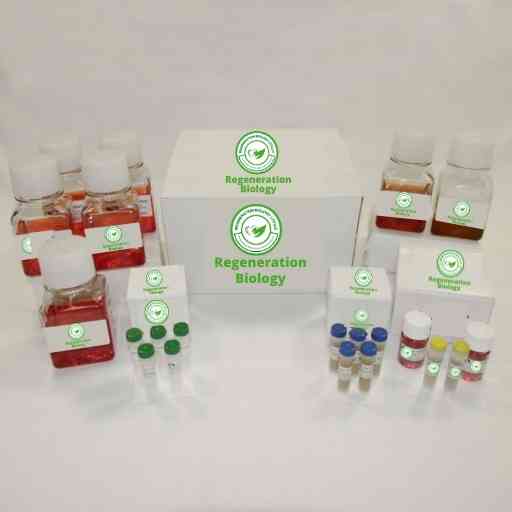
Human Dermal Fibroblasts (HDFs), Type 1 Diabetes Donor
INTENDED USE
This product is for research use only (RUO). Not for use in diagnostic or therapeutic procedures.
IMPORTANT USER NOTE
These cells exhibit biological characteristics associated with the obese donor phenotype, which may impact their growth, differentiation, and metabolic behavior compared to cells from lean donors. It is the responsibility of the user to determine the suitability of this product for their specific application. Proper training in the handling of human-derived materials is required.
PRODUCT DESCRIPTION
Regeneration Biology offers Human dermal fibroblasts from Type 1 Diabetes (HDF-T1D) donors are isolated from the dermal layer of skin tissue obtained from donors with a clinically confirmed diagnosis of Type 1 diabetes mellitus. These cells are cryopreserved at the earliest possible passage to preserve their in vivo-like characteristics and disease-specific phenotype.
HDFs are the principal architects of the extracellular matrix (ECM) and play a critical role in wound healing, inflammation, and tissue integrity. HDFs from a T1D background provide a vital model for studying the cellular and molecular mechanisms underlying impaired wound healing, a severe and common complication of diabetes. These cells may exhibit altered proliferation, migration, ECM remodeling, and inflammatory responses, making them essential for diabetes research, drug discovery, and the study of diabetic complications.
KEY FEATURES & BENEFITS
Disease-Relevant Model: Sourced from verified Type 1 Diabetic donors, providing a physiologically relevant system to study diabetic dermopathy and impaired wound healing.
Key Cellular Player in Fibrosis & Repair: Ideal for studying ECM deposition, contraction, and cell-ECM interactions in a diabetic context.
Characterized Phenotype: Verified for expression of standard fibroblast markers (Vimentin, Fibronectin) and the absence of epithelial and endothelial contaminants.
Quality Controlled: Every lot is tested for viability, sterility, and proliferative capacity to ensure experimental consistency.
Comprehensive Donor Data: Supplied with extensive donor information, including diabetes history, HbA1c levels, and medication.
QUALITY CONTROL SPECIFICATIONS
Each lot is tested to meet the following release criteria:
Viability (post-thaw): ≥ 80% (Test Method: Trypan Blue Exclusion)
Cell Yield per Vial: ≥ 0.5 million or 1 million viable cells (Test Method: Cell Count)
Morphology: Spindle-shaped, fibroblastic (Test Method: Microscopic Evaluation)
Immunofluorescence: Positive: Vimentin, Fibronectin; Negative: Cytokeratin (Epithelial), CD31 (Endothelial) (Test Method: IF Microscopy)
Proliferation Assay: Positive for population doubling within specified timeframe (Test Method: Functional Assay)
Microbiological Sterility: No growth (Test Method: USP <71>)
Mycoplasma: Negative (Test Method: PCR Method)
APPLICATIONS
Diabetic Wound Healing Research: Model impaired cell migration, proliferation, and ECM synthesis in vitro.
Fibrosis & Scarring Studies: Investigate altered collagen deposition and contractile activity.
Drug Screening: Test compounds aimed at enhancing fibroblast function and promoting healing in a diabetic context.
Co-culture Systems: Ideal for establishing models with keratinocytes (to study re-epithelialization) or immune cells to investigate inflammation.
Cellular Senescence & Aging: Study accelerated aging and senescence pathways in diabetic complications.
ECM-Biology: Analyze the composition and mechanical properties of the diabetic ECM.
CELL CULTURE INFORMATION
Materials Supplied
Product: HDF-T1D-RG33001 (Cryopreserved Vial)
Components: One vial contains 0.5 × 10⁶ or 1.0 × 10⁶ viable cells in cryopreservation medium.
Recommended Media & Reagents
Complete Growth Medium: Fibroblast Growth Medium Kit (Cat. No. M-RG22510)
Subculture Reagents:
Phosphate Buffered Saline (PBS), without Ca²⁺ and Mg²⁺
Trypsin/EDTA solution (0.25%)
Trypsin Neutralization Solution (TNS) or complete growth medium containing serum.
Thawing and Plating Procedure
Quick Thaw: Remove the vial from liquid nitrogen and immediately place in a 37°C water bath. Gently agitate until only a small ice crystal remains (≈1-2 minutes).
Decontaminate: Spray the vial with 70% ethanol before transferring to a biosafety cabinet.
Transfer and Dilute: Gently transfer the cell suspension to a 15 mL conical tube. Slowly add 5-9 mL of pre-warmed complete growth medium drop-wise to dilute the cryoprotectant (DMSO).
Centrifuge: Spin at 200 × g for 5 minutes.
Resuspend and Plate: Aspirate the supernatant and gently resuspend the cell pellet in fresh, pre-warmed complete growth medium. Plate cells into a culture flask pre-hydrated with 2-3 mL of medium.
Recommended Seeding Density: 5,000 - 10,000 cells/cm².
Incubate: Place the culture vessel in a humidified 37°C incubator with 5% CO₂.
Medium Change: Replace the medium after 24 hours to remove any non-adherent cells or debris, and then every 2-3 days thereafter.
Subculturing Procedure
Wash: Once cells are 70-90% confluent, aspirate the medium and rinse the cell layer gently with PBS.
Trypsinize: Add enough pre-warmed Trypsin/EDTA solution to cover the cell layer (e.g., 2 mL for a T-75 flask). Incubate at 37°C for 2-4 minutes. Observe the cells under a microscope until they round up and detach.
Neutralize: Add an equal volume of pre-warmed complete growth medium or TNS to neutralize the trypsin.
Centrifuge and Resuspend: Transfer the cell suspension to a tube and centrifuge at 200 × g for 5 minutes. Aspirate the supernatant and resuspend in fresh medium.
Re-plate: Seed cells into new culture vessels at a recommended split ratio of 1:3 to 1:4.
Note: HDF-T1D may exhibit slower proliferation rates compared to healthy donor HDFs. Adjust subculture schedules and seeding densities accordingly.
Cryopreservation for Cell Storage
To bank cells, subculture as described and resuspend the pellet at 1-2 × 10⁶ cells/mL in a cryopreservation medium (e.g., FBS with 10% DMSO). Aliquot into cryovials and freeze using a controlled-rate freezer, or place vials in an isopropanol freezing container at -80°C for 24 hours before transferring to liquid nitrogen for long-term storage.
TYPICAL DONOR DEMOGRAPHICS & CLINICAL HISTORY
Diagnosis: Clinically confirmed Type 1 Diabetes Mellitus.
Age Range: 18 - 65 years
Sex: Male and Female donors available
Medication: Insulin therapy
Tissue Source: Redundant skin (e.g., from abdominoplasty) or foreskin.
Common Comorbidities: May include other autoimmune conditions or early-stage microvascular complications.
ORDERING INFORMATION
| Catalog Number | Description | Format |
|---|---|---|
| HDF-T1D-RG33001-05M | Human Dermal Fibroblasts, T1D Donor | 0.5 × 10⁶ cells/vial |
| HDF-T1D-RG33001-1M | Human Dermal Fibroblasts, T1D Donor | 1.0 × 10⁶ cells/vial |
Required Reagents:
| Catalog Number | Description | Format |
|---|---|---|
| M-RG22510 | Fibroblast Growth Medium Kit | 500 mL |
Recommended Control:
| Catalog Number | Description | Format |
|---|---|---|
| HDF-HL-RG33000-05M | Human Dermal Fibroblasts, Healthy Donor | 0.5 × 10⁶ cells/vial |
CONTACT INFORMATION
Facebook – https://www.facebook.com/plasticconsumables
Instagram – https://www.instagram.com/plasticconsumables/
LinkedIn – https://www.linkedin.com/company/plastic-consumables/about/
Twitter (X) – https://x.com/plastic_consum
YouTube – https://www.youtube.com/@PlasticConsummablesLabware